IJCAI 2026: Daily Reporting from the Conference
The international AI community is currently gathering in Bremen for the International Joint Conference on Artificial Intelligence (IJCAI), which is being held in conjunction with the European Conference on Artificial Intelligence (ECAI). GI, together with FBKI, is a Silver Sponsor of the conference and a member of the Local Press Office. In this live update, you’ll find daily coverage of the conference’s key highlights, developments, and impressions..
The International Joint Conference on Artificial Intelligence (IJCAI) was first held in Washington, D.C., in 1969 and initially took place every two years. Since 2016, it has been held annually, rotating among various host cities around the world. In 2026, it will be held jointly with the European Conference on Artificial Intelligence (ECAI) as IJCAI-ECAI 2026.
After being held in locations including Macau, Jeju (South Korea), Vienna, and Montréal, the conference will take place in Bremen for the first time. IJCAI-ECAI 2026 brings together researchers from academia and industry who are addressing current issues in artificial intelligence.
The scientific program includes technical presentations, workshops, tutorials, demonstrations, and competitions. The topics range from machine learning, robotics, and multi-agent systems to knowledge representation and natural language processing, as well as trustworthy AI and AI applications in various domains.
As a member of the Local Press Office, GI will be present on site to support coverage of the conference and provide information on program highlights and scientific awards.
Click here to visit the IJCAI-ECAI website.
15–16 August
The 35th IJCAI-ECAI 2026 conference once again brings together world-class researchers, scientists, and innovators from across the globe, this time in Bremen, Germany. As the world’s oldest conference on Artificial Intelligence, IJCAI continues its founding mission: providing a forum to discuss recent advances, debate emerging trends, and share diverse perspectives on where the field of AI should head next: this year held jointly with ECAI, the European Association for Artificial Intelligence’s annual conference.
IJCAI-ECAI 2026 kicked off on Saturday, 15 August, at the University of Bremen, which has been hosting the conference through Monday, 17 August. On Tuesday, 18 August, the conference moves to the Congress Center Bremen for the main conference program. From a busy weekend of scientific exchange and community-building to a Monday focusing on the next generation, IJCAI-ECAI 2026 continues to be a place where ideas, people, and generations of AI research come together.
Warming Up
Saturday set the pace with 13 workshops and 9 tutorials, alongside a diversity workshop Contemplating the Future of Queer AI. It was a great start to a weekend filled not only with technical exchange, but also with conversations about who is shaping AI and whose perspectives need to be part of its future.
Between corridor chats, long-overdue reunions, and casual evening dinners, the energy across the University of Bremen campus has been fantastic. At its heart, IJCAI-ECAI 2026 is all about community: reconnecting with old friends, welcoming first-time attendees, and sparking exciting new collaborations along the way.
The official conference app, Whova, offers far more than just schedule planning and agenda updates. By Monday, attendees created 55 community groups to connect with like-minded peers at IJCAI-ECAI 2026. From sharing job vacancies and ride-shares to forming impact-oriented networks, first-timer meetups, regional groups, and hobby circles (like climbing!), Whova makes it easy to spark meaningful in-person connections during the conference.
Opening the AI Box: Science Meets the Public
Sunday brought even more energy, with 18 workshops and 6 tutorials, as well as two diversity events: Accessible Aging AI: Building an Affinity Community for Diverse Human Abilities in AI and Beyond the AI Bubble: Inclusion, Networking, and the Future of AI.
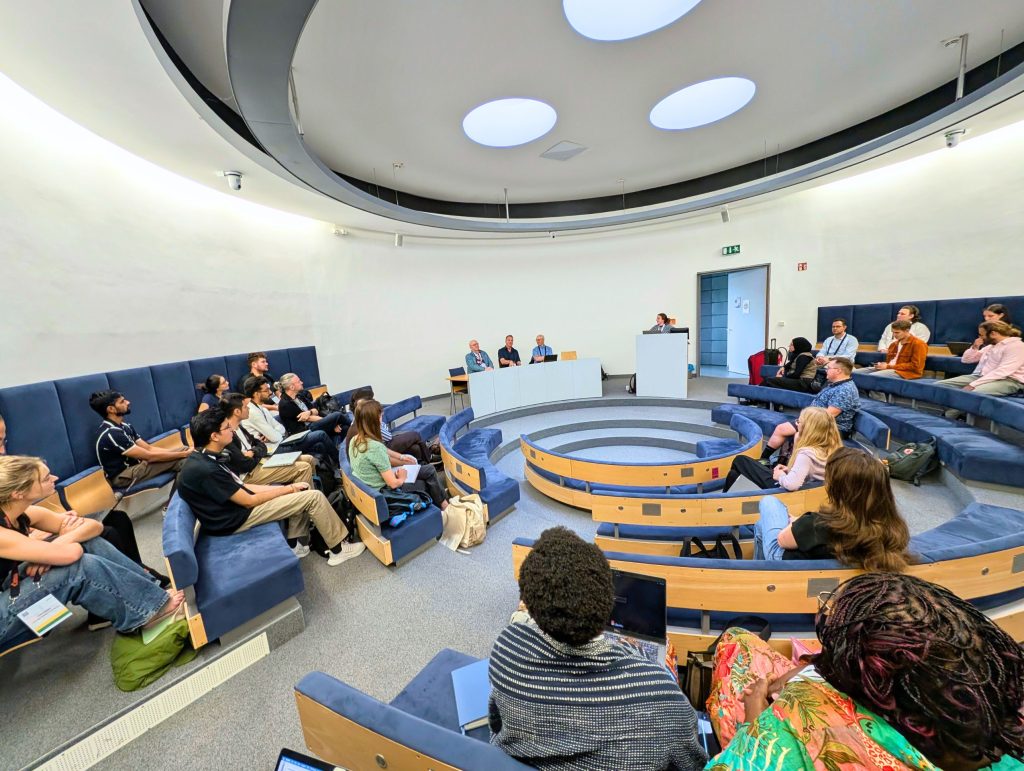
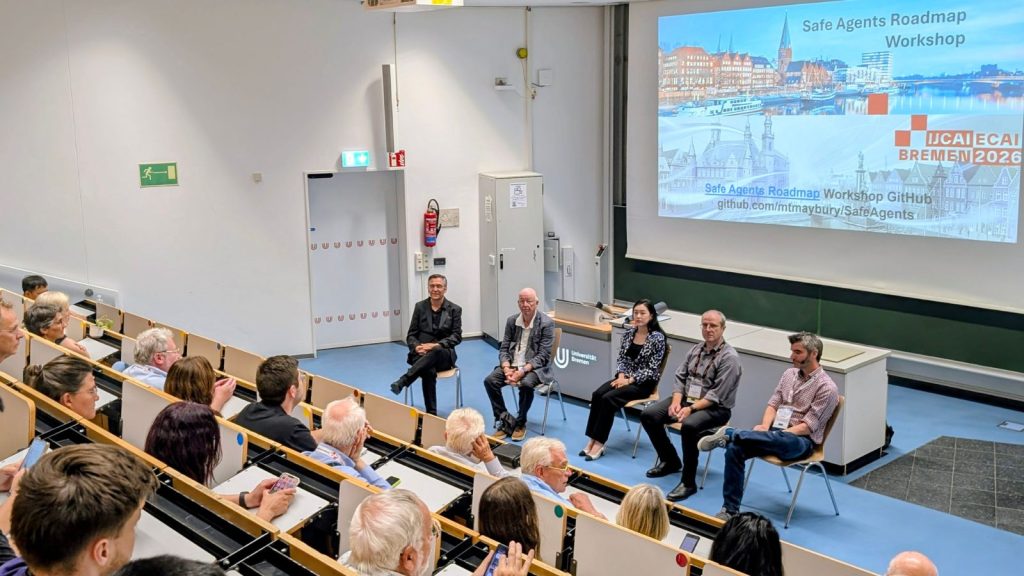
Sunday evening, we also opened the conversation to the general public beyond the conference community with IJCAI-ECAI 2026 public panel, “New Directions for Safe AI Agents.” Moderated by Dr. Mark T. Maybury, the panel brought together Wolfgang Wahlster (DFKI), Stuart Battersby (Red Hat), Josephine (Yuyin) Liu (ACM), and Mihai Christodorescu (Google), to discuss trust, human-agent interaction, open-source approaches to AI safety, and the need for governance that can keep pace with rapidly evolving AI systems. The panel’s message was clear: building safe AI agents is not only a technical challenge. It also requires thoughtful governance, transparency, collaboration, and a continued dialogue between researchers, industry, policymakers, and society. Full recap and photos of the panel is available on our LinkedIn page.
Next-Gen AI, Public Dialogue & Opening Night
Today, Monday 17 August, features 13 workshops and 10 tutorials, as well as the diversity event Global South AI, continuing our focus on bringing a wide range of experiences and perspectives into the AI conversation.
Monday also marks the IJCAI-ECAI 2026 Doctoral Consortium, an especially important part of the conference for the next generation of AI researchers. This year, 17 doctoral students were accepted with their extended abstracts and have had the opportunity to connect with 12 mentors and 3 panelists, all senior members of the IJCAI community in the weeks leading up to the conferece. The event is co-chaired by Leilani Gilpin (University of California – Santa Cruz), Maria Chang (IBM Research), Vlad Ryzhikov (Birkbeck, University of London). The co-chairs themselves once benefited from doctoral consortia when they were starting their own careers. Today, they are helping create that same opportunity for the researchers coming next. At 13:30 the Doctoral Consortia is inviting conference attendees to join the Career Pannel with Anthony Cohn(University of Leeds), Toby Walsh (UNSW Sydney), Michael Theilscher (UNSW Sydney). Photos available on our LinkedIn account.
At 16:30, the conference opens its doors again for another outreach highlight: IJCAI-ECAI 2026 AI Lecture by professor Toby Walsh (UNSW), an award-winning science communicator and leading AI researcher. His public lecture, “The AI Race,” is already fully booked, reflecting the strong public interest in understanding where the rapid development of AI may be taking us. The lecture offers a preview of themes from his forthcoming book, God AI: Boom or Doom? What to Expect When Machines Outsmart Us?
The evening will then move into the Welcome Reception, setting the stage for the official opening of the main conference on Tuesday, August 18.
From a busy weekend of scientific exchange and human connection to a Monday focused on the next generation and public dialogue, IJCAI-ECAI 2026 is building momentum. IJCAI conferences are where humanity thrives—celebrating what unites us while diving directly into the tough, essential questions about the future of AI development.
The main program officially kicks off tomorrow—be part of it!
Contact
IJCAI-ECAI 2026 is organised by the Local Arrangement Committee chaired by Prof. Tanja Schultz of Universität Bremen, Prof. Frank Kirchner of Universität Bremen and German Research Center for Artificial Intelligence (DFKI), and Dr.-Ing. Monika Michaelis of the U Bremen Research Alliance. The work of the Local Arrangement Committee in 2026 is supported by three press offices: the U Bremen Research Alliance, German Research Center for Artificial Intelligence (DFKI), and the German Informatics Society (GI). Media inquires only
Connect online
#IJCAI2026 #ECAI2026
17 August
Monday, 17 August, marked the final day of the workshop and tutorial program before the start of the main conference. The atmosphere was bittersweet: workshop participants exchanged farewells and chairs celebrated their distinct research communities, just as the main wave of attendees arrived for the main conference. Alongside the IJCAI-ECAI 2026 public AI lecture, we gathered in anticipation of the evening Welcome Reception, bringing the community together in the Übersee-Museum Bremen (Overseas Museum). Surrounded by scientific discoveries, trial-and-error breakthroughs, and fascinating exhibits, it was the perfect way to kick off the main conference.
Monday’s technical programme featured 13 workshops and 10 tutorials, as well as the diversity event Global South AI, continuing our focus on bringing a wide range of experiences and perspectives into the AI conversation. IJCAI-ECAI 2026 Doctoral Consortium, an especially important part of the conference for the next generation of AI researchers, took place throughout the day, with a special open-to all attendees Career panel.
Navigating Career Paths
The IJCAI-ECAI 2026 Doctoral Consortium was co-chaired by Leilani Gilpin (University of California, Santa Cruz), Maria Chang (IBM Research), and Vlad Ryzhikov (Birkbeck, University of London). Bringing together 17 accepted extended abstracts from 12 countries, the event provided early-career researchers with the invaluable opportunity to discuss their work, explore career paths, and build lasting networks alongside 12 senior mentors and 3 distinguished panelists. The room filled with curiosity as young scholars presented their work and engaged in Q&A.
During the Career Panel featuring Anthony Cohn (University of Leeds), Toby Walsh (UNSW Sydney), and Michael Thielscher (UNSW Sydney), the panelists sparked lively discussions on a myriad of topics: On career paths, the panelists noted the rare fluidity between academia and industry. Switching tracks can feel daunting, but as Toby Walsh reassured attendees, taking calculated risks pays off since very few decisions are truly irreversible. The panel also tackled the conference review crisis. While Toby Walsh could read every IJCAI abstract as IJCAI Programme Chair in 2011, doing so in 2026 is impossible. Anthony Cohn cautioned that academic pressures cause “salami slicing”—splitting projects into minimal papers, which dilutes research quality. Addressing automated review tools, Michael Thielscher noted that using LLMs for peer review has yielded poor results compared to human evaluation. Closing on an inspiring note, the panelists urged early-career researchers to get involved in reviewing and workshop organizing, while emphasizing that today’s AI scientists must actively engage with policymakers, media, and the public on safety and ethics.
Between Big Tech, Politicians, and the Public
The public IJCAI-ECAI 2026 AI Lecture on “The AI Race” was delivered by Toby Walsh in the hall of democracy of the independent State of Bremen, in the celebratory hall of the Bremen Parliament. The event, which was fully booked with 150 attendees, was opened by Henrike Müller, Senator for Environment, Climate, and Science, in the Bremen Parliament building. She called for a responsible balance between the opportunities and risks of artificial intelligence. Next, Jutta Günther, Rector of the University of Bremen and President of the U Bremen Research Alliance, emphasized that Bremen’s strength lies in flat hierarchies and interdisciplinarity put into action. After expressing gratitude to the Local Organizing Team of IJCAI-ECAI 2026, she passed the floor to Toby Walsh, who kicked off his lecture with a notion how his childhood vision is becoming reality, and reflected on examples of AI used for good before examining three instances of irresponsible use in the tech industry. On the positive side, AI is already transforming society for the better: accelerating the discovery of life-saving antibiotics like Halicin, delivering personalized digital education through platforms like Smart Sparrow, and powering smartphone apps that detect ocean rip currents to prevent drownings. Yet, the primary threats of AI stem not from sci-fi fears of superintelligent systems going rogue, but from the immediate, real-world harms perpetuated by irresponsible Big Tech practices. Platforms continue to rush unsafe chatbots to market—sometimes with tragic impacts on youth mental health—while mining copyrighted creative works without consent and profiting from AI-generated scam advertisements. Compounding these issues, politicians have repeatedly failed to enact strong guardrails, often prioritizing industry lobbying over independent technical advice. Ultimately, Toby Walsh’s advice for humanity is to avoid repeating the mistakes of social media by establishing real accountability before another generation is sacrificed for corporate profit.
A panel discussion followed, bringing together four voices with distinct vantage points: Tanja Schultz (University Bremen), speaking to Bremen’s own research culture; Antonio Krüger (DFKI) and Ralf Möller (German Informatics Society’s Chapter for Artificial Intelligence), weighing in from DFKI and the Gesellschaft für Informatik; and Toby Walsh, casting the conversation in international terms. Over fifteen minutes, the panelists pressed further into the questions Walsh had raised, debating how researchers, industry, and policymakers might turn calls for AI accountability into enforceable practice.
Contact
IJCAI-ECAI 2026 is organised by the Local Arrangement Committee chaired by Prof. Tanja Schultz of Universität Bremen, Prof. Frank Kirchner of Universität Bremen and German Research Center for Artificial Intelligence (DFKI), and Dr.-Ing. Monika Michaelis of the U Bremen Research Alliance. The work of the Local Arrangement Committee in 2026 is supported by three press offices: the U Bremen Research Alliance, German Research Center for Artificial Intelligence (DFKI), and the German Informatics Society (GI). Media inquires only Insert link
Connect online
#IJCAI2026 #ECAI2026
LinkedIn, X (former Twitter), Facebook, BlueSky, Mastodon
18 August
Tuesday, 18 August, marked the official opening of the IJCAI-ECAI 2026 main conference. After three days of workshops, tutorials and outreach events on the University of Bremen campus, the community moved into the Congress Centrum Bremen (CCB) for the start of the four-day technical programme, running through 21 August with 858 accepted papers out of 6342 full submission across the main track, special tracks, journal track, survey track and demonstrations track. The programme also features early career spotlight talks, demos, and competitions. The mood shifted from the intimacy of the workshop rooms to the scale of a global gathering, as delegates from around the world filled the CCB for the Opening Ceremony.
Bremen Welcomes the World of AI
The Opening Ceremony formally welcomed the IJCAI-ECAI 2026 community to Bremen, setting an inspiring tone for the week ahead. Led by Conference Chair Francesca Toni (Imperial College London), the event officially kicked off with a moment of solemn reflection. She led an in memoriam segment and a one-minute moment of silence to honor the great minds of AI who passed away in the past year: Joe Halpern, Tony Hunter, and Lin Padgham.
Following this tribute, the ceremony transitioned to welcoming remarks from key representatives of the local and regional support infrastructure. Dr. Alexandra-Gwyn Paetz delivered a brief welcome address on behalf of the Federal Ministry of Research, Technology and Space, emphasizing the impact of AI research and Germany’s place in the AI universe. On behalf of the third LAC Co-Chair, Frank Kirchner (DFKI), Local Organizing Committee Chairs Tanja Schultz (Bremen University) and Monika Michaelis (UBRA) conveyed a remote welcome message to the attendees of IJCAI-ECAI 2026, in which he expressed his sincere regret for being unable to attend in person. Highlighting the host city’s unique identity, both LAC co-chairs emphasized Bremen’s transdisciplinary approach—combining scientific excellence with societal accountability—before introducing the conference program. They made special mention of the upcoming Conference Banquet at the Weserstadion. Far from a typical conference banquet, the event features interactive live cooking stations and an exciting robot soccer match demo by B-Human, a 13-time world champion and 16-time regional titleholder in the RoboCup Humanoid Soccer League.
Adding to the civic pride, Dr. Andreas Bovenschulte, Prime Minister of the Free and Hanseatic City of Bremen, captured the significance of the moment: “The IJCAI-ECAI is bringing one of the most distinguished international conferences on Artificial Intelligence to Bremen. The choice for Bremen as the location of this important event is an outstanding acknowledgement for our city as a centre of science and technology. It shows the impact of AI in research, economics and society, and is, furthermore, clear evidence of the excellent conditions Bremen offers to researchers and businesses today.”
With the city officially extending its welcome, attention turned to celebrating academic excellence. President of the IJCAI Board of Trustees Kate Larson (University of Waterloo, Google DeepMind) took the stage to announce the major IJCAI Awards alongside their presentation slots. Nicholas R. Jennings (Vice-Chancellor and President of Loughborough University), received the IJCAI 2026 Award for Research Excellence for “seminal contributions to the field of multi-agent systems, including algorithms for multi-agent coordination and the principles of human-agent teamwork, and for his pioneering applications of autonomous agents and multi-agent systems.” Jiajun Wu (Stanford University) was honoured with the IJCAI 2026 Computers and Thought Award for “foundational contributions across computer vision, generative AI, and robotics, uniting neural and symbolic representations to build machines that understand and interact with the physical world.” David C. Parkes (Harvard University) received the 2026 John McCarthy Award for “foundational contributions to the interface of AI and economics, specifically for pioneering algorithmic mechanisms that ensure efficiency, fairness, and incentive alignment in high-stakes multi-agent environments.” And Christian Bessiere (CNRS, University of Montpellier) was presented with the 2026 Donald E. Walker Distinguished Service Award, recognising his extensive service and contributions to the field throughout his career. In his welcome speech Christian Bessiere describes his love story with IJCAI, which was not a love at first sight.
The celebration of excellence continued across partner organizations. The president of the European Association for Artificial Intelligence EurAI, Holger Hoos (RWTH Aachen University) announced the winners of the EurAI Distinguished Service Award, awarded annually to two individuals who have made exceptional contributions to the European AI community. The 2026 recipients are Jérôme Lang (CNRS-LAMSADE, Université Paris-Dauphine) and Luc De Raedt (KU Leuven).
Sylvie Thiébaux (Australian National University & LAAS-CNRS, University of Toulouse), Co-Editor-in-Chief of the Artificial Intelligence Journal, then presented the coveted AIJ Awards. The Prominent Paper Award recognizes outstanding papers published not more than 7 years ago in the AI Journal that are exceptional in their significance and impact. The Classic Paper Award recognizes outstanding papers published at least 15 calendar years ago in the AI Journal that are exceptional in their significance and impact. The winners of the AIJ 2026 Classic Paper Award are: Sarit Kraus, Daniel Lehmann, Menachem Magidor for their paper: Nonmonotonic reasoning, preferential models and cumulative logics. Read the paper here
The winners of the AIJ 2026 Prominent Paper Award are: Samy Badreddine, Artur d’Avila Garcez, Luciano Serafini, Michael Spranger for their paper: Logic Tensor Networks. Read the paper here
On behalf of the Editors-in-Chief of JAIR, Holger Hoos returned to announce the IJCAI-JAIR Award winners, and their presentation slots. The 2026 IJCAI-JAIR Best Paper Prize goes to the paper “The Computational Complexity of Understanding Binary Classifier Decisions” by Stephan Wäldchen, Jan Macdonald, Sascha Hauch, and Gitta Kutyniok. Read the paper here
The 2026 IJCAI-JAIR Test of Time Award goes to the paper “SMOTE: Synthetic Minority Over-sampling Technique” by Nitesh Chawla, Kevin Bowyer, Lawrence Hall, and Philip Kegelmeyer. Read the paper here
Bringing the opening proceedings to a close, IJCAI-ECAI 2026 Program Chair Diego Calvanese (University of Bozen-Bolzano) provided an overview of the IJCAI-ECAI 2026 program, announcing the Distinguished Paper Prizes as well as the presentation slots for distinguished papers, invited speakers, and panels. He emphasized: “A quality-driven review process was maintained because we limited the number of submissions, also on behalf of PPI policy, and fantastic reviewers.” With the awards conferred and the roadmap for the week set, Francesca Toni returned to the podium to deliver the final closing words, officially declaring IJCAI-ECAI 2026 open.
Looking back on Monday’s fully booked public AI Lecture in the Bremen Parliament, Senator Henrike Müller, the Senator for Environment, Climate, and Science, reflected on why public engagement remains central to the conference: “Artificial intelligence is already changing our everyday lives, which is why the discussion about it should not be limited to specialists and researchers. Through IJCAI-ECAI 2026’s public outreach programs, such as the AI Lecture, we are bringing international AI research directly into the urban community. Science thrives on open exchange: on clearly communicating the opportunities, being transparent about the limitations, and discussing how we can shape artificial intelligence responsibly.”
From Hype to AI Societies: Nick Jennings on Agentic AI
Agentic AI is one of the highly discussed topics of this year’s IJCAI-ECAI. In his invited talk, “The Past, Present and Future of Agentic AI,” Nicholas R. Jennings offered a clear and timely perspective on a field marked by both rapid progress and high expectations. Jennings, Vice-Chancellor and President of Loughborough University, received the IJCAI 2026 Award for Research Excellence for his seminal contributions to multi-agent systems, including coordination, human-agent teamwork and pioneering real-world applications of autonomous agents. His lecture began with the present moment. Agentic AI, he noted, is seeing one of the most aggressive adoption curves among emerging technologies. At the same time, the field is at a “peak of inflated expectations.” As he put it, only half in jest: “The IT department of every company in the future will be the HR department of agentic AI.” Jennings reminded the audience, we are not looking at something new. Today’s research is built on decades of work on autonomous agents and multi-agent systems. Jennings closed with a message to the research community: strong science depends on the interaction between theory and practice, is done in teams and requires persistence. His final conclusion was clear: agentic AI is here to stay. Professor Jennings also reflects on his research journey in his blog, “The Age of AI Societies“.
Bridging the Divide: Luciano Serafini on Neuro-Symbolic AI
Addressing one of the defining debates in computer science, Luciano Serafini’s invited address at IJCAI-ECAI 2026 offered a compelling vision for the future of artificial intelligence. His presentation on Neuro-Symbolic AI served as a timely milestone, bridging decades of discussions between symbolic logic and sub-symbolic machine learning. Central to this vision is Logic Tensor Networks. Recognized at the conference with the prestigious AIJ 2026 Prominent Paper Award, the seminal publication “Logic Tensor Networks”—co-authored by Luciano Serafini, Samy Badreddine, Artur d’Avila Garcez, and Michael Spranger—seamlessly integrates rigorous logical reasoning with deep learning architectures. As the AI community seeks more explainable, robust, and trustworthy systems, this award-winning research stands as a cornerstone for next-generation intelligence, sparking crucial debate and innovation across both academia and industry. Read the award-winning paper
IJCAI-ECAI 2026 keynotes are recorded, and the recording will be made available after the conference on the conference website.
Diversity and Inclusion Lunch at the historic Bremen townhall
The traditional Diversity and Inclusion Lunch was held under the patronage of Bremen’s Prime Minister Andreas Bovenschulte at the historic Bremen Town Hall, providing a unique setting for the event. Bovenschulte used the opportunity to emphasize the importance of developing and applying artificial intelligence responsibly and in a way that is firmly grounded in society. The D&I lunch was supported by the Alumni Association of the University of Bremen.
Innovation Floor: Meet Our Exhibitors
Hall 4 of the Congress Centrum Bremen opened its doors on Tuesday and is quickly becoming the vibrant heart of the exhibition, running alongside the technical programme through 21 August. Between sessions, attendees wander the floor to meet this year’s sponsors and exhibiting partners over coffee and poster sessions, discovering the wide range of research and industry work behind IJCAI-ECAI 2026 — the full list of this year’s generous sponsors and partners is available on the conference sponsors page. Attendees can meet directly with company representatives and explore the various exhibitions at the booths. For example, at the DFKI booth, visitors could follow a live stream of the Underwater Robotics AI Showcase & Challenge, broadcast directly from the Maritime Exploration Hall of the German Research Center for Artificial Intelligence (DFKI). The event brought together AI researchers, students, industry leaders, and policymakers for a full day of exchanging ideas and exploring new frontiers in AI-driven underwater robotics.
Networking Reception at the Bremen Booth
The networking reception of the Bremen senate in the exhibition at the Bremen booth offered entrepreneurs and company representatives from Bremen a focused opportunity to experience IJCAI-ECAI 2026 up close. In exchanges with partners from academia, business, and politics, participants discussed current developments in artificial intelligence and explored possible connections for future cooperation. The poster sessions gave companies direct insights into emerging AI applications and models, while the relaxed atmosphere created space for concrete conversations and new contacts.
Hans Georg Tschupke, Head of Department Industry, Innovation, Digital Transformation, the Senator for Economic Affairs, Ports and Transformation, welcomed guests: “IJCAI-ECAI 2026 highlights what sets Bremen apart as an AI hub: strong research, innovative companies, and direct exchange between research and industry. This is where collaboration with real-world impact takes shape—creating real benefits for business and society.”
Björn Portillo, Chairperson of Bremen digitalmedia, co-organizer of the reception: “As Bremen’s business association for the digital economy, Bremen digitalmedia, we are delighted to welcome IJCAI-ECAI to Bremen. The networking reception is a great opportunity for companies in Bremen to connect with academia and the research community. This exchange is especially valuable in times of rapid change and given the growing impact of artificial intelligence.”
For companies, the event also opened up new perspectives on how AI can be translated into practical applications.
“Great to join the world-leading AI conference IJCAI in Bremen. It was a great opportunity for my colleagues and me to widen our AI network in Bremen and to learn more about the really impressive progress in AI research and development. We are looking forward to implementing some AI ideas in the aerospace projects supported by partners from the #ECOMAT network” says Dr.-Ing. Hubertus Lohner, Lead Techno Centre ECOMAT, AIRBUS Operations.
The reception made clear that the use of AI in business depends not only on technological progress, but also on concrete use cases and strong digital foundations.
“The conversations reinforced my belief that sustainable digital transformation requires both standardized processes and a clear focus on developing meaningful use cases. This creates the right foundation for using AI where it can truly add value. At DMK/Arla Group, this is the approach we are taking to build a strong, digitally capable and self-reliant business function” resumes Dr. Annegret Koehler-Werzner, Group Team Lead GBS Customer Journey and Digitalization.
AI, Up Close – for the public
Tuesday evening, the AI Lounge series kicked off at the Open Space am Domshof with AI x Media, the first of four public panel discussions running through the conference week, followed by AI x Administration, AI x Education and AI x Workplace.
From 17:30 to 18:30, media researcher Wiebke Loosen (Leibniz Institute for Media Research, Hans-Bredow-Institut), Frank Schulte (Radio Bremen), and Gabriela Molina León (Aarhus University) discussed how artificial intelligence is changing journalism – from authorship and editorial processes to the way audiences assess information. The panel examined how AI impacts journalism, addressing questions of authorship and disinformation. In a nutshell, panelists emphasized that transparency builds trust. While AI is a useful tool, on-the-ground reporting, journalistic judgment, and content responsibility must remain strictly in human hands. Complete transparency regarding how and when AI is used is essential to preserving media credibility. The discussion also highlighted the critical issue of data access. AI can only work with the information it has access to. When media organizations such as Radio Bremen exclude their journalistic content from AI systems, these models lack important sources for research, context, and summarization. This can lead to AI-generated answers reflecting only a limited range of available sources. At the same time, publishers are taking different approaches: while some deliberately withhold their content, others enter into licensing agreements with major AI and tech companies. The panel, organised by Laura Spillner and Johanna Rockstroh (University of Bremen), drew conference delegates and Bremen residents alike into the conversation.
The KI x Open Lab – Open Through 22 August 2026
Since opening its doors on Monday, the KI x Open Lab — a special part of Bremen’s Summer of AI — continues to welcome visitors. From 17 to 22 August 2026, the Kassenhalle in the Forum am Domshof is a temporary learning arena dedicated to artificial intelligence. The common denominator: AI has long been part of everyday life, education, research and work. This makes it all the more important to develop skills, seize opportunities and critically assess risks. Beyond the international scientific conference, the Lab is deliberately aimed at young people, school groups, apprentices and the wider public. In the mornings, school groups visit the Digital Impact Lab. Registration is available here: https://impact-lab.eu/summer_of_ai/ . From 1 to 5 p.m. each day, talks, panels, exhibits, workshops and hands-on stations provide insights into topics such as AI in medicine, education, work, robotics, learning algorithms and the responsible use of AI. The full programme can be found on the KI x Open Lab website: https://impact-lab.eu/summer-of-ai-programm/.
Contact
IJCAI-ECAI 2026 is organised by the Local Arrangement Committee chaired by Prof. Tanja Schultz of Universität Bremen, Prof. Frank Kirchner of Universität Bremen and German Research Center for Artificial Intelligence (DFKI), and Dr.-Ing. Monika Michaelis of the U Bremen Research Alliance. The work of the Local Arrangement Committee in 2026 is supported by three press offices: the U Bremen Research Alliance, German Research Center for Artificial Intelligence (DFKI), and the German Informatics Society (GI). Media inquires only: https://2026.ijcai.org/press/
Connect online
#IJCAI2026 #ECAI2026
19 August
Wednesday, 19 August, brought the IJCAI-ECAI 2026 main conference into full stride at the Congress Centrum Bremen. The day combined Early Career Spotlight Talks, major invited presentatio]ns, discussions on the practical implementation of the EU AI Act, scientific award ceremonies, Industry Day sessions, guided exhibition tours, and public outreach events across the city. From Barbara Plank’s keynote on the value of human disagreement for AI and David C. Parkes’ John McCarthy Award lecture on agent societies to startup challenges, company showcases, and the evening banquet at Weserstadion, the programme reflected the full range of IJCAI-ECAI 2026: excellent research, responsible governance, real-world application, and exchange with society.
Barbara Plank on the Myth of Ground Truth
Much of modern AI continues to rely on a powerful simplifying assumption: that for every problem there exists a single correct answer, a single ground truth. In her keynote, “The Myth of Ground Truth: What Human Disagreement Teaches Us About AI,” Barbara Plank, LMU Munich, argued that this assumption is often at odds with the complex, ambiguous and inherently human environments in which AI systems operate. Drawing on her research into human disagreement, ambiguity and the evaluation of foundation models, she made the case that variation in human judgment should be treated as a meaningful part of how AI systems are built and evaluated, rather than something to average away before a model ever sees the data. “Variation is frequently not noise to be eliminated, but signal to be understood.” (Barbara Plank)
David Parkes: From Intelligent Agents to Agent Societies
David C. Parkes, Harvard University, recipient of the 2026 IJCAI John McCarthy Award for his foundational contributions to the interface of AI and economics, specifically for pioneering algorithmic mechanisms that ensure efficiency, fairness, and incentive alignment in high-stakes multi-agent environments, opened his invited talk “From Intelligent Agents to Agent Societies” with a personal look back at the beginnings of his research and at the teachers and role models who shaped his work.
In his invited talk, he builds upon the initial question: “Let’s assume for this talk that we can build generally intelligent agents. What comes next?” His answer? Multi-Agent AI. Rather than focusing solely on individual agent capabilities, Parkes turned the spotlight on entire societies of interacting systems – bringing the core concepts of combinatorial auctions to life using famous Bremen culinary specialties, such as Labskaus, Beck’s beer, Klaben, Knipp, Matjes, kale, and Hachez chocolate as metaphors. For him, the next frontier of AI isn’t just about smarter individual models. It’s about how autonomous systems interact, share resources, negotiate conflicting goals, and align incentives. As Parkes emphasized, the agent societies we design, study, and build are deeply embedded within human society – meaning the rules, incentives, and institutional structures we build for them are just as vital as the AI itself. Following his presentation, David Parkes was presented with the award certificate by Bo An, Nanyang Technological University, Programme Chair for IJCAI 2027.
IJCAI-ECAI 2026 keynotes are recorded, and the recording will be made available after the conference on the conference website.
From Legislation to Practice: The EU AI Act in Focus
The EU AI Act entered into force on 1 August 2024 and became applicable on 2 August 2026, with some exceptions. At the invited session on the EU AI Act, Jeroen Delfos, European Commission, DG CNECT A/2, highlighted the EU’s shift from developing the AI Act to putting it into practical effect. A key message was the importance of technical standards developed by CEN, CENELEC and ISO, which can provide organisations with clear, practical pathways to demonstrate compliance.
Researchers and academics were encouraged to contribute directly to standardisation work, codes of practice, expert task forces, and stakeholder consultations. Particular attention was given to the challenges facing universities and SMEs, which often lack the resources of large technology companies. The EU is therefore developing guidance and support to make compliance more accessible and proportionate.
Delfos clarified that not every educational use of AI is necessarily subject to all AI Act obligations, despite education including some high-risk use cases. Universities should identify which specific provisions apply to their activities rather than assuming that all AI use is prohibited or classified as high-risk. The discussion also addressed emerging challenges, including AI-generated content, explainability, human oversight and agentic AI. In the coming months, new task forces will work on interoperable detection methods, watermarking and marking, benchmarking, and transparency for AI-generated content. Social mediarecommendation algorithms remain primarily regulated under the Digital Services Act (DSA), although general-purpose AI models presenting systemic risks may also fall under the AI Act. Delfos further clarified that Article 14 on human oversight does not require human involvement at every step of a decision-making process, but rather requires AI systems to be designed to enable appropriate monitoring, tracing and human intervention.
Overall, the discussion underlined that effective AI governance will depend not only on legislation, but also on practical standards, technical expertise, stakeholder participation and continued international cooperation.
Early Career Spotlight Talks
The IJCAI-ECAI 2026 Early Career Spotlights (ECS) sessions are continuing in full swing. Designed as an invited speaker program, ECS highlights exceptional early career researchers who have already made significant research contributions to artificial intelligence and demonstrate immense promise for future impactful work. Following Tuesday’s insightful presentations by Francesco Leofante (Imperial College London), Ziyue Li (Technical University of Munich), Thomy Phan (University of Bayreuth), and Zeynep G. Saribatur (TU Wien), Wednesday’s program turned the spotlight toward compelling talks from Wenqi Fan (The Hong Kong Polytechnic University), Steven James, Yaqing Wang (Beijing Institute of Mathematical Sciences and Applications), and Hua Wei (Arizona State University).
Celebrating scientific excellence
On Wednesday, attendees had the opportunity to hear from the first of this year’s three IJCAI Distinguished Paper Award winners. These prestigious awards recognize some of the most outstanding research papers delivered at the conference each year. IJCAI-ECAI 2026 Programme Chair Diego Calvanese, University of Bozen-Bolzano, presented the Distinguished Paper Award to Jeremy Vollen, Northwestern University, during his talk, honoring the paper “Approximate Strategyproofness in Approval-based Budget Division”, authored by Haris Aziz, Patrick Lederer, Jeremy Vollen. Read the paper here.
Congratulations to Jaap Jumelet, University of Amsterdam, who was awarded the prestigious EurAI Dissertation Award for his outstanding PhD thesis “Finding Structure in Language Models”. EurAI Board member and 2025 EurAI Disseration Award Chair Fredrik Heintz, Linköping University, presented the certificate on stage of IJCAI-ECAI 2026. First awarded in 1998 to Paolo Liberatore, this honor celebrates over two decades of groundbreaking doctoral research in AI evaluated on originality, impact, and excellence.
Where Research Meets Application: IJCAI-ECAI 2026 Industry Day
The IJCAI-ECAI 2026 Industry Day delivered a dynamic showcase of cutting-edge applications, sovereign technology infrastructure, and collaborative innovation, bringing together global tech leaders and the local startup ecosystem.
The morning sessions opened with insights into high-scale real-time translation from DeepL, where speakers Leonie Neuhäußer and Kristina Geißler demonstrated advanced voice and document translation capabilities designed to dismantle global communication barriers. Conference attendees are invited to the DeepL booth to take on the speed challenge: see how your pace stacks up against Claude.
T-Systems followed, with Björn Weidenmüller presenting Europe’s first Industrial AI Cloud launched in February 2026 by T-Systems International in partnership with Deutsche Telekom and NVIDIA. Concluding the morning corporate spotlights, Mulang Onando from SAP detailed how combining Business Knowledge Graphs with agentic systems and semantically linked tabular data enables enterprise AI to understand context and execute complex reasoning within systems like SAP Joule.
In the afternoon, the focus turned toward applied engineering and the growth of the local ecosystem. Joint perspectives were delivered by Udo Gödel, CONTACT Software and Jörn Syrbe, team neusta, setting the stage for an engaging session hosted by the State of Bremen. Moderated by Mareike Mgwelo of Starthaus Bremen & Bremerhaven, the interactive startup feature brought together local founders Rafael Reisenhofer of Count from Above, Chris Robin Wübbeler of ellamind, and Dr. Christian Geier of prokube. Rather than standard pitches, the founders presented active business and technical challenges directly to the IJCAI community. This format invited researchers and industry experts to collaborate in real time, bridging academic expertise with startup agility to elaborate on real-world industry problems.
Guided Tours for company representatives
Four guided tours at the IJCAI-ECAI 2026 Exhibition offered company representatives and entrepreneurs a curated look at how artificial intelligence is being developed and applied across robotics, language, health, and digital business processes.
Starting from the Bremen stand, the groups visited selected company and research booths for short expert talks, demonstrations, and discussions tailored to each tour topic. The stops brought together perspectives from international research and industry and showed how AI is already being applied across a wide range of fields.
The AI x Robotics tour was led by Dr. Nina Hoyer (University of Bremen / DFKI), AI x Language by Katalina Kopka (University of Bremen), AI x Health by Lena Wollschläger (U Bremen Research Alliance), and AI x Digital Business Processes by Derk H. Schönfeld (U Bremen Research Alliance).
Across all four tours, the shared focus was on making current AI developments tangible, connecting research with real-world applications, and creating opportunities for direct exchange with experts at the exhibition.
AI Meets Soccer: Banquet at Weserstadion
The day wrapped up with a special highlight: the official IJCAI-ECAI 2026 banquet at Bremen’s Weserstadion, home of Bundesliga club Werder Bremen. Located directly on the Weser River, the stadium usually holds up to 42,100 spectators. On Wednesday evening, it became the setting for an atmospheric conference gathering.
In the VIP areas North and East, attendees enjoyed the opportunity to meet, exchange ideas, and sample a variety of culinary offerings. The stands and stadium interior were also open, illuminated in green and white and offering space to linger in mild evening temperatures.
A further highlight was the demonstration by B-Human, the robot soccer team jointly developed by the University of Bremen and DFKI. With 13 RoboCup World Championship titles and numerous German championships to its name, B-Human brought artificial intelligence and soccer together in a setting closely associated with Bremen.
Local Tech Humor Meets IJCAI-ECAI 2026
IJCAI- ECAI 2026 attendees were treated to a touch of local tech humor courtesy of IJCAI-ECAI 2026 Publicity Co-Chair Rolf Drechsler (DFKI / University of Bremen) and Jannis Stoppe (German Aerospace Center – DLR). The duo, known as the creators of NŒRDMAN—a popular webcomic exploring technology, geek culture, and life in Northern Germany—crafted a special edition illustration created specifically for IJCAI-ECAI 2026. Discover more tech humor and comics at: www.noerdman.de
AI, Up Close – for the public
As a public outreach event and part of the Summer of AI in Bremen, Wednesdays AI Lounge on Domshof brought the discussion around artificial intelligence directly into the city.
Dustin Klepper (neuraflow GmbH), Dr. Christina Gloerfeld (University of Bremen), and Prof. Dennis-Kenji Kipker (Bremen University of Applied Sciences) discussed how AI can support the digital transformation of public administration, from more efficient processes and better services to the legal, technical, and organisational requirements for responsible use.
Organized by Dr.-Ing. Thomas Eßmeyer from the University of Bremen, the German-language event created an open forum for exchange between experts and the public on the opportunities and challenges of AI in public institutions.
The KI x Open Lab – Open Through 22 August 2026
Since opening its doors on Monday, the KI x Open Lab — a special part of Bremen’s Summer of AI — continues to welcome visitors. From 17 to 22 August 2026, the Kassenhalle in the Forum am Domshof is a temporary learning arena dedicated to artificial intelligence. The common denominator: AI has long been part of everyday life, education, research and work. This makes it all the more important to develop skills, seize opportunities and critically assess risks. Beyond the international scientific conference, the Lab is deliberately aimed at young people, school groups, apprentices and the wider public. In the mornings, school groups visit the Digital Impact Lab. Registration is available here. From 1 to 5 p.m. each day, talks, panels, exhibits, workshops and hands-on stations provide insights into topics such as AI in medicine, education, work, robotics, learning algorithms and the responsible use of AI. The full programme can be found on the KI x Open Lab website.
Contact
IJCAI-ECAI 2026 is organised by the Local Arrangement Committee chaired by Prof. Tanja Schultz of Universität Bremen, Prof. Frank Kirchner of Universität Bremen and German Research Center for Artificial Intelligence (DFKI), and Dr.-Ing. Monika Michaelis of the U Bremen Research Alliance. The work of the Local Arrangement Committee in 2026 is supported by three press offices: the U Bremen Research Alliance, German Research Center for Artificial Intelligence (DFKI), and the German Informatics Society (GI). Media inquires only: https://2026.ijcai.org/press/
Connect online
#IJCAI2026 #ECAI2026
LinkedIn, X (former Twitter), Facebook, BlueSky, Mastodon
20 August
Thursday, 20 August, marked the penultimate day of IJCAI-ECAI 2026 at Congress Centrum Bremen. With just one day remaining, the program featured an impressive lineup of Early Career Spotlight Talks, major invited presentations, scientific award ceremonies, interactive challenges, live demos, and citywide public outreach events. Highlights included Tinne Tuytelaars’s keynote on computer vision and Jiajun Wu’s Computers and Thought Award lecture on physical and visual intelligence. The day concluded with a vibrant Student Reception in the evening, celebrating the next generation of AI researchers.
Why Visual Representation Learning Is Far From Solved
“It doesn’t sound very fancy,” admitted Tinne Tuytelaars, KU Leuven, at the start of her keynote, Good Visual Representations: Easier Said Than Done. Despite popular belief that AI has mastered “seeing,” she argued that teaching computers to truly understand images remains far from solved. Today’s vision models can easily tag objects in a photo, but they struggle with real-world context like spatial arrangements, depth, and fine details. When systems rely mostly on text descriptions, these critical visual subtleties get lost. Tuytelaars urged researchers to look beyond simple object recognition, stressing that building truly smart AI requires teaching models to perceive the world as clearly and reliably as humans do. True visual understanding requires far more than simply recognizing and naming objects in a frame; it demands an ability to capture complex configurations and structural relationships accurately. Concluding her talk, Tuytelaars emphasized that solving these core challenges is essential for building flexible, robust, and trustworthy systems.
Beyond Flat Pixels: Seeing the Physical World Through Code
Following on from the theme of visual structure, IJCAI 2026 Computers and Thought Award winner Jiajun Wu, Stanford University, delivered the next keynote, Building Visual and Physical Intelligence Through Code. He argued that while much of computer vision treats scenes as flat arrangements of pixels, AI must learn to see the physical world as it truly is: “Scenes are composed of objects; objects possess their own geometry, texture, material, and physical properties“. Drawing on research across computer vision, generative AI, and robotics, Wu showed how knowledge from physics and computer graphics can guide neural networks to infer these deeper properties directly from raw data—even with limited 3D training data available. By teaching models to perceive intrinsic geometry and material traits, his work paves the way for AI that doesn’t just look at pictures, but truly understands and interacts with the physical world.
Early Career Spotlight Talks
The IJCAI-ECAI 2026 Early Career Spotlights (ECS) sessions are continuing. Designed as an invited speaker program, ECS highlights exceptional early career researchers who have already made significant research contributions to artificial intelligence and demonstrate immense promise for future impactful work. On Thursda’s we were following insightful presentations by Zhao Ren (University of Bremen / Cognitive Systems Lab), and Mohammad Rostami (University of Southern California / USC Information Sciences Institute).
Celebrating scientific excellence
On Thursday, attendees had the opportunity to hear from the two of this year’s three IJCAI Distinguished Paper Award winners. These prestigious awards recognize some of the most outstanding research papers delivered at the conference each year. IJCAI-ECAI 2026 Programme Chair Diego Calvanese, Free University of Bozen-Bolzano, presented the second Distinguished Paper Award to Yurun Gu, Télécom SudParis / Institut Polytechnique de Paris, during their talk, honoring the paper “Tuple Inconsistency Measures: Toward Explaining Query Answers“, authored by Yurun Gu, Badran Raddaoui, Yue Ma, Aikaterini Tzompanaki, Nicole Bidoit. Read: https://ijcai-preprints.s3.us-west-1.amazonaws.com/2026/7822.pdf
The third Distinguished Paper Award went to the paper StreamTimer: Efficient Inference for Long-Context Time Series Transformers, by Xiyu Meng, Yuhan Wu, Canran Xiao, Yabo Dong, Duanqing Xu. Read: https://ijcai-preprints.s3.us-west-1.amazonaws.com/2026/2468.pdf
Where Research Meets Application
Throughout the day, attendees engaged with demonstrations, challenges, while the IJCAI-ECAI 2026 Exhibition Area remains active, serving as a primary hub for academic-industry exchanges and technical showcases, throughout Friday.
The day concluded with the conference’s Student Reception in the historic venue of Bremen’s old harbour. The inspiring evening event connecting first-time attendees and early-career researchers with one another, fostering the peer networks and collaborative spirit that will shape the future of AI. This marked the final social gathering of IJCAI-ECAI 2026. Sincere thanks go to Local Social Chairs Katalina Kopka, University of Bremen, and Klaus Eickel, Fraunhofer MEVIS and Bremerhaven University of Applied Sciences, for organizing an extraordinary evening.
AI, Up Close – for the public
As a public outreach event and part of the Summer of AI in Bremen, Thursday’s AI Lounge on Domshof brought the discussion around artificial intelligence directly into the city – this time on the topic of AI in Education.
Organized by Institut für Informationsmanagement Bremen GmbH (ifib), the German-language apprentice Lara Marx, student and developer Kevin Saukel, Professor of Applied Linguistics Sarah Brommer, and Professor of Information Management Andreas Breiter explored how AI is transforming learning, teaching, and knowledge assessment. The discussion highlighted the growing importance of critical thinking, interdisciplinary collaboration, and responsible AI use.
A key takeaway: AI is already part of Germanys everyday education, but its integration remains largely unstructured. Rather than restricting AI, participants emphasized the need for stronger digital and AI literacy, clear guidelines, and new approaches to teaching and learning.
The audience also raised important questions about technological sovereignty, ethics, democratic knowledge, and the reliance of Bremen schools on AI tools, soft- and hardware provided by major U.S. technology companies.
The KI x Open Lab – Open Through 22 August 2026
Since opening its doors on Monday, the KI x Open Lab — a special part of Bremen’s Summer of AI — continues to welcome visitors. From 17 to 22 August 2026, the Kassenhalle in the Forum am Domshof is a temporary learning arena dedicated to artificial intelligence. The common denominator: AI has long been part of everyday life, education, research and work. This makes it all the more important to develop skills, seize opportunities and critically assess risks. Beyond the international scientific conference, the Lab is deliberately aimed at young people, school groups, apprentices and the wider public. In the mornings, school groups visit the Digital Impact Lab. Registration is available here. From 1 to 5 p.m. each day, talks, panels, exhibits, workshops and hands-on stations provide insights into topics such as AI in medicine, education, work, robotics, learning algorithms and the responsible use of AI. The full programme can be found on the KI x Open Lab website.
Contact
IJCAI-ECAI 2026 is organised by the Local Arrangement Committee chaired by Prof. Tanja Schultz of Universität Bremen, Prof. Frank Kirchner of Universität Bremen and German Research Center for Artificial Intelligence (DFKI), and Dr.-Ing. Monika Michaelis of the U Bremen Research Alliance. The work of the Local Arrangement Committee in 2026 is supported by three press offices: the U Bremen Research Alliance, German Research Center for Artificial Intelligence (DFKI), and the German Informatics Society (GI). Media inquires only: https://2026.ijcai.org/press/
Connect online
#IJCAI2026 #ECAI2026
21 August
Friday, 21 August, marked the final day of IJCAI-ECAI 2026 at Congress Centrum Bremen. Bringing the joint conference to a memorable close, the final day’s program featured keynotes on robot reinforcement learning and IJCAI in the world, an engaging panel on robotics, exhibits, last poster session, and the official closing and awards ceremony. Highlights included Jan Peters’ opening keynote on motor skill acquisition in autonomous systems, Georgina Curto’s update on the ‘IJCAI in the World’ initiative, and the passing of the torch to future conference host cities.
Early Career Spotlight Talks
The IJCAI-ECAI 2026 Early Career Spotlights (ECS) sessions came to a close on Friday. Designed as an invited speaker program, ECS highlighted exceptional early career researchers who have already made significant research contributions to artificial intelligence and demonstrate immense promise for future impactful work. Closing out the program were two fascinating talks from Wuyang Chen, Simon Fraser University, and Aryan Deshwal, University of Minnesota, Twin Cities.
Jan Peters on Inductive Biases in Robot Reinforcement Learning
Opening Friday’s presentation lineup, Jan Peters, Technische Universität Darmstadt / German Research Center for Artificial Intelligence (DFKI), addressed a long-standing vision across AI, robotics, and cognitive science: autonomous robots capable of assisting humans in daily life. While enabling robots to learn context-triggered tasks is a crucial first step, Peters emphasized that current learning techniques still struggle to scale to high-dimensional manipulators and humanoid systems. To learn efficiently from just a few trials without exploring endless impractical solutions, robots cannot search every possible outcome—they must prioritize solutions through strong “inductive biases.” He argued that for these frameworks to successfully generalize to new tasks, these assumptions must be deeply rooted in general principles from robotics, physics, and control theory. Empirical evaluations across several physical systems demonstrated the framework’s effectiveness, showing how domain-informed learning enables anthropomorphic robot arms to master diverse motor skills. These ranged from foundational tasks like ball-in-a-cup and paddling to high-speed table tennis, juggling, complex object manipulation, and even a robot learning to skateboard.
Georgina Curto on IJCAI in the World
IJCAI in the World: In the afternoon keynote, Georgina Curto (United Nations University Institute in Macau) presented updates on the ‘IJCAI in the World’ initiative, aimed at expanding academic engagement across the Global South. Curto highlighted three years of continuous following the locally driven initiatives across South Africa, Senegal, Rwanda, Uganda, and Nigeria, highlighting local organizations such as the Deep Learning Indaba. The initiative’s recent IJCAI Symposium in Nigeria drew 175 paper submissions from 34 countries (led by Nigeria, Ethiopia, and Kenya), with accepted papers slated for a special IJCAI proceedings volume. Curto invited the broader research community to actively support calls for papers to make AI research globally accessible.
Robotics Panel: Strong Views, Sharp Debates, Valuable Insights
One of the livelier sessions of the conference brought together experts from academia and industry to discuss the future of AI-powered robotics. The panel highlighted both the potential and the challenges of deploying intelligent robots in real-world environments, from homes and healthcare to industrial and subsea applications.
Moderated by Elsa Andrea Kirchner (University of Duisburg-Essen / DFKI Robotics Innovation Center) and chaired by Diego Calvanese (Free University of Bozen-Bolzano), the panelists Michael Beetz (University of Bremen), Peter Kampmann (Rosenxt Group, Head of Subsea Solutions) and Jan Peters (TU Darmstadt / DFKI) debated on a range of topics – from foundation models, robot reasoning, safety, explainability, and human-robot interaction to energy constraints, sensing technologies, and regulatory requirements. This debate was a powerful reminder that in a disruptive era of rapid technological change, progress depends on challenging assumptions and openly discussing competing viewpoints. Conferences like the IJCAI-ECAI 2026 provide a rare and valuable forum where experts from different disciplines and countries can engage in exactly these kinds of high-level conversations.
Closing session
The official IJCAI-ECAI 2026 Closing Session commenced with Competitions Co-Chair Jochen Renz, The Australian University, announcing the winners across this year’s 14 technical competitions. Programme Chair Diego Calvanese shared final conference statistics, presenting detailed demographic breakdowns of total attendance, topic distributions, and international paper acceptances.
Conference leadership honored key contributors shaping the organization:
President of the IJCAI Board of Trustees, Kate Larson, University of Waterloo / Google DeepMind, recognized Kristian Kersting, TU Darmstadt, for his dedicated service as outgoing IJCAI Secretary-Treasurer and formally welcomed Sriram Natarajan, University of Texas at Dallas, as his successor.
Larson also annouced the newly elected IJCAI Trustees Ana Paiva, University of Lisbon), and Min-Ling Zhang, Southeast University.
Recognition
Sincere gratitude was extended to all session chairs whose guidance ensured smooth discussions throughout the conference tracks. Heartfelt thanks also went to the dedicated volunteers representing over 50 countries, the rigorous paper reviewers, and the entire global community for keeping the conference a premier world forum for academic exchange and feeling the pulse of AI.
IJCAI-ECAI 2026 General Chair Francesca Toni, Imperial College London, brought the entire local arrangements team to the stage, offering special thanks to Vesna Sabljakovic-Fritz, IJCAI Executive Director & Exacutive Secretary, and Francisco Cruz, IJCAI Chief Administrator & Program Committee Administrator in Chief / Brainful Labs SL, for their tireless efforts in executing the event.
Looking Ahead ECAI 2027 and IJCAI 2027
The closing ceremony concluded with announcements for upcoming host locations:
ECAI 2027: Manolis Koubarakis announced Athens, Greece, as the host city for the 30th European Conference on Artificial Intelligence.
IJCAI 2027: Vesna Sabljakovic-Fritz revealed that IJCAI 2027 will take place in Kyoto, Japan (7–13 August 2027), accompanied by a satellite event on Hengqin Island (15–17 August 2027).
IJCAI-ECAI 2026 Conference Chair, Francesca Toni, wished attendees safe travels and officially brought the joint 35th International Joint Conference on Artificial Intelligence and European Conference on Artificial Intelligence to a close, followed by a final networking farewell reception.
AI, Up Close – for the public
As a public outreach event and part of the Summer of AI in Bremen, Friday’s final AI Lounge on Domshof brought the discussion around artificial intelligence directly into the city—this time focusing on the topic of AI in the Workplace.
Organized by Katalina Kopka, University of Bremen, the panel featured Arved Steinhauer, Zukunftszentrum Nord, Daniel Kühn, Bremen Chamber of Labour, Ann-Kathrin Sobeck-Martens, OFFIS Institute for Information Technology, and Nico Autzen, neusta mobile solutions. Together, the speakers explored how AI is transforming individual work and organizational practices. The discussion emphasized the growing importance of lifelong learning, clear communication between management and employees, and the consensus that AI is reshaping roles rather than simply eliminating them. Panelists noted that adaptation has always been central to both professional and personal life. However, the defining shift of the current AI wave lies in automation targeting knowledge work—sectors previously less directly impacted by earlier, manual-labor-focused industrial transformations.
The KI x Open Lab – Open Through 22 August 2026
The KI x Open Lab Public outreach efforts continue through 22 August at the Kassenhalle in the Forum am Domshof. As part of Bremen’s Summer of AI, the temporary learning arena remains open to school groups, apprentices, and the public, offering hands-on exhibits, workshops, and panels covering medicine, education, and responsible AI use.
Contact
IJCAI-ECAI 2026 is organised by the Local Arrangement Committee chaired by Prof. Tanja Schultz of Universität Bremen, Prof. Frank Kirchner of Universität Bremen and German Research Center for Artificial Intelligence (DFKI), and Dr.-Ing. Monika Michaelis of the U Bremen Research Alliance. The work of the Local Arrangement Committee in 2026 is supported by three press offices: the U Bremen Research Alliance, German Research Center for Artificial Intelligence (DFKI), and the German Informatics Society (GI). Media inquires only: https://2026.ijcai.org/press/
Connect online
#IJCAI2026 #ECAI2026
Press Coverage
German Press
- idw-online.de (Wissenschaftspressedienst, mehrere Meldungen), u.a. Bremen's Application a Success – Germany to Host Renowned AI Conference Again after 43 Years, (29. July 2022)
- Bremen Innovativ / bremen-research.de: mehrere Pressemitteilungen zur IJCAI-ECAI 2026 – https://www.bremen-research.de/services/pressemitteilungen/bremen-ijcai-ecai-2026 (weitere Meldung: https://www.bremen-innovativ.de/en/veranstaltungen/ijcai-ecai-bremen-2026/) (05. September 2025)
- Weser-Kurier: Bremen wird zur Bühne für die weltweit wichtigste KI-Konferenz IJCAI, (10. August 2026)
- Digital Public Health: IJCAI kommt nach Bremen: Was eine der wichtigsten KI-Konferenz der Welt für die Stadt bedeutet (10. August 2026)
- buten un binnen (Radio Bremen): Agenten bis Robotik: KI-Weltkongress lockt 2.500 Experten nach Bremen, (15. August 2026)
- RND: Warum die weltweite KI-Elite nach Deutschland kommt (15. August 2026)
- ad-hoc-news.de: KI-Weltkongress in Bremen: Erste IJCAI-ECAI seit 43 Jahren, (16. August 2026)
- IT Daily: IJCAI-ECAI in Bremen mit 2.800 internationale KI-Experten (17. August 2026)
- Deutschlandfunk: KI-Konferenz steigt erstmals seit 40 Jahren in Bremen (17. August 2026)
- APOC Bremen: Weltweit führende KI-Konferenz kommt im August 2026 nach Bremen, (August 2026)
International Press
- Tech Times: "EU AI Act Enforcer Joins IJCAI-ECAI 2026 as World's Oldest AI Conference Opens Saturday" (14.08.2026)
- Tech Times: "CLIP Image Encoder Fine-Tuning Hurts Cross-Domain AI Models, IJCAI Study Finds" (17.08.2026)
- Tech Times: "AI Agent Conflicts Need Designed Environments, Not Better Models, Safety Panel Finds" (17.08.2026)