What about the E?
Das E in STEM wird noch immer etwas zu klein geschrieben. Dabei sind sich viele Fachleute einig, dass Engineering in Schulen und außerschulischen Kontexten viel stärker gefördert werden sollte. Wie aber kann der Weg dahin aussehen? Und was können wir dabei im internationalen Austausch lernen? Diesen Fragen ging die Begleitkonferenz „International Perspectives on STEM Education“ der MINTvernetzt-Jahrestagung nach. GI-Redakteurin Rika Baack war live dabei.
English version below
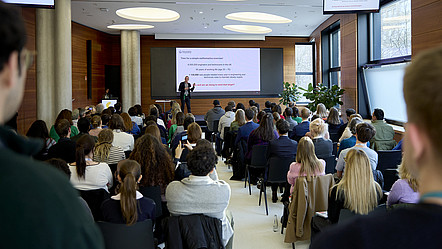
„Kinder lernen keine Mathematik, weil sie eine Karriere in der Mathematik anstreben“, erklärte Martina Pometlova auf der Bühne im Berliner Rocket Tower. Mathe gelte als Fundament für unendlich viele Disziplinen und deshalb müsse eben jede und jeder da durch. Aber wieso gilt dasselbe nicht für andere Kompetenzen? „Unabhängig von ihren Berufswünschen sollten Kinder verstehen, wie Informatik funktioniert, wie sie sie nutzen, um ihr Leben zu verbessern, wie sie sich auf ihr Leben auswirkt und welche Risiken ihre Nutzung birgt.“
„International Perspectives on STEM Education: What about the E?“, eine Begleitkonferenz der Jahrestagung von MINTvernetzt, hat sich am 11. Februar dem E im STEM gewidmet. Die Konferenz wurde organisiert von Amazon Future Engineer, MINTvernetzt, der Initiative Meet and Code und der Gesellschaft für Informatik e.V. STEM – das steht für Science, Technology, Engineering und Mathematics. Es ist das Äquivalent der deutschen Bezeichnung MINT, ein Sammelbegriff der naturwissenschaftlichen Disziplinen. Trotz Förderprogrammen und zahlreichen engagierten Initiativen fehlt es in diesen noch allzu oft an Fachkräften, an angemessener Ausstattung in Schulen und an Mädchen- und Frauenbeteiligung.
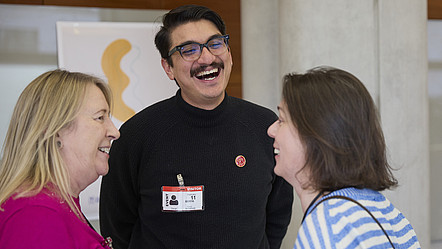
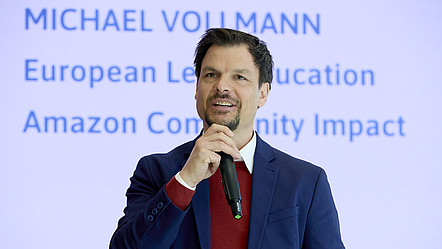
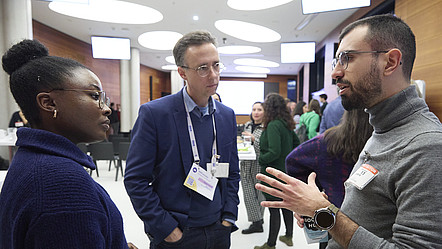
Gerade im Engineering, also in all jenen Wissenschaften, die sich um Technik drehen, wären diese Missstände sehr deutlich. Das unterstrich auch Michael Vollmann, Education Lead Europe bei Amazon, der die Gäste auf der Veranstaltung willkommen hieß. „Es gibt inzwischen unzählige Menschen, die Engineering an neue Generationen herantragen wollen und tolle Ideen umsetzen – sei es in Schulen oder darüber hinaus. Die Fähigkeiten, die sich Kinder hier aneignen, eröffnen ihnen wichtige Zukunftschancen. Deshalb sehen wir es als unsere Aufgabe, diese Arbeit wertzuschätzen und zu fördern.“ Vor Ort waren deshalb viele Engagierte wie etwa die Teams des CoderDojo Belgium oder der Associazione L'aquilone – Impresa Sociale. Manche von ihnen stellten ihre bisherigen Meilensteine vor und gingen mit den Teilnehmenden in den Austausch, einige erhielten zudem eine Anerkennung in Form der „Meet and Code Awards 2024“.
In seiner Keynote brachte Rhys Morgan, Director for Education and Skills an der Royal Academy of Engineering, noch eine etwas andere Perspektive ein. Er hat in einem aufwendigen Prozess Bildungsinstitutionen, Wettbewerbe, Stiftungen oder Projekte zusammengestellt, die Engineering fördern. Das Ergebnis: Eine breit gefächerte STEM-Landschaft, deren Initiativen sich regional und inhaltlich oft überlappen. Sein Fazit: So viele Angebote sorgen bei Kindern eher für Verwirrung und Überforderung. Braucht es also mehr Vernetzung? Wo müssen Akteure ansetzen, um Kinder tatsächlich zu erreichen?
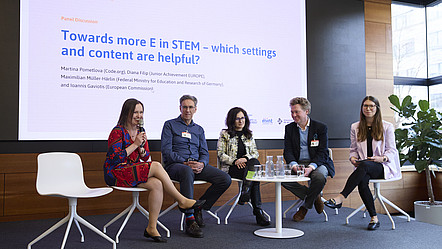
Dem gingen Martina Pometlova von Code.org, Diana Filip von Junior Achievement EUROPE, Maximilian Müller-Härlin vom Bundesministerium für Bildung und Forschung und Ioannis Gaviotis von der Europäischen Kommission in der Fishbowl-Diskussion „Towards more E in STEM – which Settings and Content are helpful?“ nach. Filip sprach sich dafür aus, die Industrie an die Schulen zu holen, um die Lücke zwischen den Welten Schule und Arbeit zu überbrücken. Offenheit sei das, worauf alles hinausläuft, meinte Müller-Härlin: Schulen müssten offen gegenüber anderen Institutionen und Projekten sein. Und Lehrende offen für eine neue Dynamik in ihrem Klassenzimmer, fügte Pometlova hinzu, in der sie von den Kindern lernen.
Einige der Projekte, deren Teams teils aus ganz Europa anreisten, wurden an diesem Tag auch mit den „Meet and Code Awards 2024“ geehrt. Die Initiative Meet and Code unterstützt mit Amazon als Hauptförderer Non-Profit-Organisationen in Europa, die jungen Menschen Zugang zu digitalen Fähigkeiten und zum Programmieren ermöglichen. Die Jurymitglieder Michael Vollmann, Michal Szwarc von TechSoup und Clemens Frede vom Haus des Stiftens verliehen die Awards: In der Kategorie Girls do IT! gewann das Projekt „Girl Power - Robotic Rope Pulling“ der ArchitectsPL Foundation, für den Fokus Diversität „Level Up Against Discrimination: Creative Game Jam“ von Sorora e.V. In der Kategorie Code for the Planet wurde „My ECO-Future City“ der Associazione L'aquilone – Impresa Sociale ausgezeichnet.
Neben der Awards Ceremony konnten die Teilnehmenden im Rahmen der Session „Meet my project“ noch mehr innovative Projektideen kennenlernen. Die Teams des CoderDojo Belgium, Class Chats, Hacker School und weiteren Initiativen hatten 180 Sekunden Zeit, ihr Konzept auf der Bühne zu präsentieren, um sich dann den Fragen und Ideen der internationalen Teilnehmenden in kleinen Gruppen zu stellen.
So viele Engagierte an einem Ort zu versammeln, bot auch die Möglichkeit, Know-how und Erfahrungsberichte zu teilen. Eine gemeinsam erstellte Leseliste der Teilnehmenden gibt es hier zum Nachlesen: https://nextcloud.gi.de/s/QAanRPYzYaGkmPf
What about the E?
All too often, the E in STEM is still written a little too small. Yet many experts agree that engineering should be promoted to a much greater extent in schools and extracurricular contexts. But how can we get there? And what can we learn from international exchange? The companion conference “International Perspectives on STEM Education” of the MINTvernetzt annual conference explored these questions. Editor Rika Baack was on site.
“Children don't learn math because they want to be become mathematicians," explained Martina Pometlova on stage at the Rocket Tower in Berlin. Math is considered the foundation for an infinite number of disciplines and therefore each and every one of us has to study it, she pointed out. But why isn't the same true for other skills? “Regardless of their career aspirations, children should understand how computer science works, how they can use it to improve their lives, how it impacts their lives and what the risks of using it are.”
“International Perspectives on STEM Education: What about the E?”, a companion conference to the MINTvernetzt annual conference on February 11, was dedicated to the E in STEM. The conference was organized by Amazon Future Engineer, MINTvernetzt, the Meet and Code initiative and the German Informatics Society. STEM stands for Science, Technology, Engineering and Mathematics. It is the equivalent of the German term MINT, a collective term for the natural science disciplines. Despite funding programs and numerous committed initiatives, there is often still a lack of specialists, adequate equipment in schools and the participation of girls and women.
These shortcomings are particularly evident in engineering, that is, in all those sciences that revolve around technology. This was also emphasized by Michael Vollmann, Education Lead Europe at Amazon, who welcomed the guests to the event. “There are now countless people who want to bring engineering to new generations and implement great ideas, be it in schools or other contexts. The skills that children acquire here open up important future opportunities for them. That's why we see it as our duty to value and promote this work.” Many of those engaged people, such as the teams from CoderDojo Belgium or Associazione L'aquilone – Impresa Sociale were therefore on site. Some of them presented their milestones to date and engaged in discussions with the participants; some also received recognition in the form of the “Meet and Code Awards 2024”.
In his keynote speech, Rhys Morgan, Director for Education and Skills at the Royal Academy of Engineering, brought in a slightly different perspective. In an elaborate process, he compiled educational institutions, competitions, foundations and projects that promote engineering. The result: a wide-ranging STEM landscape whose initiatives often overlap regionally and in terms of content. His conclusion: so many offers tend to confuse and overwhelm children. So do we need more integration? On what do stakeholders need to focus in order to actually reach children?
Martina Pometlova from Code.org, Diana Filip from Junior Achievement EUROPE, Maximilian Müller-Härlin from the German Federal Ministry of Education and Research and Ioannis Gaviotis from the European Commission explored this in the fishbowl discussion “Towards more E in STEM - which settings and content are helpful?”. Filip spoke out in favor of bringing industry into schools to bridge the gap between the worlds of school and work. Openness is what it all boils down to, said Müller-Härlin: schools need to be open to other institutions and projects. And teachers open to a new dynamic in their classroom, added Pometlova, in which they learn from the children.
Some of the projects, whose teams traveled from all over Europe, were also honored on this day with the “Meet and Code Awards 2024”. The Meet and Code initiative, with Amazon as their main sponsor, supports non-profit organizations in Europe that give young people access to digital skills and programming. Jury members Michael Vollmann, Michal Szwarc from TechSoup and Clemens Frede from Haus des Stiftens presented the awards: In the Girls do IT! category, the “Girl Power - Robotic Rope Pulling” project by the ArchitectsPL Foundation won, while “Level Up Against Discrimination: Creative Game Jam” by Sorora e.V. won for the Diversity focus. In the Code for the Planet category, “My ECO-Future City” by Associazione L'aquilone - Impresa Sociale was honored.
In addition to the Awards Ceremony, participants were able to get to know even more innovative project ideas during the “Meet my project” session. The teams from CoderDojo Belgium, Class Chats, Hacker School and other initiatives had 180 seconds to present their concept on stage and then answer the questions and ideas of the international participants in smaller groups.
Gathering so many committed people in one place also offered the opportunity to share know-how and experience reports. A reading list compiled by the participants can be found here: https://nextcloud.gi.de/s/QAanRPYzYaGkmPf