"We Need More Than Data-Driven AI" Interview with Marius Lindauer
Marius Lindauer is professor at Leibniz University Hannover and vice dean of the Faculty of Electrical Engineering and Computer Science. His research centers on automated machine learning (AutoML), with the goal of making AI development more efficient, more accessible and easier to use. Elena Müller spoke with him at IJCAI , where he delivered a Sunday tutorial on AutoML and attended as part of NAIRA, the Northern AI Research Alliance of Lower Saxony. In this interview, he looks back on his own path from symbolic reasoning to machine learning, explains why symbolic AI was never really a dead end, discusses why future AI will need richer models of the physical world, and reflects on the difficulties of abductive reasoning and Europe’s challenge to regulate AI without stifling research or startups.
Interview: Elena Müller, GI
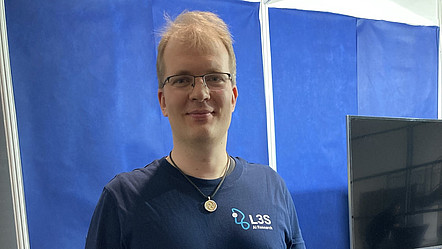
Marius Lindauer and IJCAI
Elena Müller: To start, could you briefly introduce yourself and tell me why you decided to come to IJCAI this time?
Marius Lindauer: I’m a professor at Leibniz University Hannover and currently also vice dean at the Faculty of Electrical Engineering and Computer Science. I work on automated machine learning, making AI development more efficient, more accessible and easier to use. Here at IJCAI I had the pleasure of giving a tutorial on Sunday, which was very well received, and we’re also here as part of NAIRA, the Northern AI Research Alliance of Lower Saxony, together with partners like HBI, the L3S Research Center and Jade University.
EM: And what was your tutorial about?
ML: It was on automated machine learning, my own expertise, together with Marcel Wever and Lena Kästner. We talked about why we should automate machine learning: thoughtful design leads to more efficient and more effective models, and we also covered aspects like sustainability and human-centeredness, topics that matter a great deal for the AI community right now, especially in Europe.
Symbolic AI Was Never a Dead End
EM: Not long ago, rule-based AI was considered a dead end. Now hybrid systems that combine those methods with today’s data-driven models are back in fashion. Is AI coming full circle, or is this something new?
ML: When I started working in AI, I was also on the logic and symbolic reasoning side. I was working in Boston during my PhD, and even back then I wouldn’t have called it a dead end. Companies like Potassco Solutions, led by Torsten Schaub, show how powerful symbolic reasoning can be. If you know your setting well, a production environment where you know the rules and constraints, you can use approaches like answer set programming to optimize workflows. Companies still pay real money for that. Where it did reach its limits was scaling to complex, uncertain systems. Think of train operations in Germany: trains are often delayed, there’s a lot of uncertainty, and you cannot realistically enumerate every possible event in a rule-based system. Data-driven machine learning was a response to that. We could collect large amounts of data, identify patterns, and reason from them. But purely data-driven systems are limited too, so I agree we need more than what we currently have. The big question is what that additional component should be: a knowledge graph, explicit reasoning, physics-informed networks, or retrieval-based architectures. There are different approaches on the table, and we haven’t agreed on a single answer yet.
World Models and Embodied AI
EM: Many researchers argue that future AI systems will need some internal understanding of how the physical world actually works, causes and effects, physics, objects, rather than just predicting the next likely word. Is building this kind of world model essential for reliable AI?
ML: I think it’s one very important component. Text is powerful, and everyone now uses some kind of large language model, but text is also limited. When I think about the next generation of AI, I imagine something like robotics or embodied AI: systems that have real physical contact with the world. In that setting, text alone isn’t enough. An embodied system needs to understand, or at least encode, what it means to grab something and put it back, or what happens when a glass becomes emptier as you drink from it. Some of this has to be experiencedby the system itself, and some of it we can explicitly teach. We probably need both. I’m very impressed by the recent breakthroughs on world models. Some of the most impressive work still comes from Google DeepMind: systems that can work with video, generate plausible continuations, move the virtual camera, and keep track of how shadows and objects would behave. Connecting such world models with embodied agents that act reliably in reality is one of the big next challenges.
Reasoning and the Hard Case of Abduction
EM: Which type of reasoning do we still struggle with the most: drawing strict logical conclusions, or spotting general patterns?
ML: It depends very much on the setting and on what is at stake. Applying AI in a medical context, where errors can have serious consequences, is very different from a robot exploring an outdoor environment where the setting is more forgiving. We’ve seen that large language models are now reasonably good at induction and deduction. They’re not perfect, but good enough that people rely on them for everyday, low-stakes tasks. Where they do struggle is abduction: observing something surprising and coming up with a plausible explanation that wasn’t obvious from past patterns. Large language models tend to be weak here and often overoptimistic, which limits their reliability for things like generating genuinely novel research hypotheses. For low-stakes, everyday reasoning, current systems can already be very helpful. For high-stakes contexts or truly new, unexpected situations, abductive reasoning is still a hard open problem.
Technical Oversight: Guiding or Just Checking AI
EM: Should a rule-based part just double-check the output of a data-driven model, or should it actively steer and guide the whole reasoning process? How should AI be controlled technically?
ML: What we’re often doing right now is more the former: we let the agentic system run and then check afterward whether the results are correct. Many recent breakthroughs, in mathematics for example, follow this pattern: let the system explore and produce candidate solutions, then verify them. At the same time, there’s a lot of work trying to imitate classical reasoning strategies within modern machine learning systems. I say “imitate” because these are still correlation-based models, not causal ones, but they can learn to mimic aspects of classical reasoning. In practice, I think we need a combination: classical reasoning to guide systems so they build something useful and efficient, and post-hoc checksto filter out wrong or unsafe outputs. The real problem comes in domains where we can’t easily check the outcome afterward. If a robot moves through the world and interacts with people, we don’t have a separate reasoning system that can fully verify whether every action was optimal or even acceptable, maybe at a high level of abstraction, but certainly not for every detail.
From Single Systems to Socio-Technical Evaluation
EM: Should AI research shift from optimizing single systems toward designing and evaluating AI as part of broader socio-technical systems that include humans?
ML: Yes and no. First, we need to understand why we do things the way we do now. It’s a matter of complexity and resources: what a single research team, especially at a university, can realistically do. We’d love to run large-scale studies in complex settings with many participants, but who should pay for them, and who has the time? I don’t just mean the researchers, but also the participants, who have jobs and private lives. In our own work we’ve tried to conduct human-centered studies, because we want to design systems for humans, not to replace them, but it was extremely hard to find participants. Platforms like Mechanical Turk don’t always provide the most qualified participants, and some of them now use AI themselves to complete tasks, which undermines the value of the data. So I agree that more large studies and more socio-technical evaluation would be great, and we should invest in them, but we also have to be realistic: we can’t do them all the time and at all scales. What we’ve done over the last decades, evaluating specific models and improving architectures step by step, has also been very successful, from early deep learning to transformers to the quite capable models that now run locally on a phone.
EM: What should future AI benchmarks actually measure, especially when we consider the broader societal context in which these systems are used?
ML: It depends on the application and on what the AI system is supposed to do. Take explainability as an example. There are now many explainability methods, and many of them have their justification, but they address different needs. Auditing an AI system in a legal context, to check that it behaves reasonably and doesn’t discriminate, needs explanations that characterize the behavior of the model as a whole. A bank or insurer facing a customer who challenges a specific decision needs an explanation for that individual case: why this particular person was treated in a certain way.
These are different types of explanation, reflecting different societal contexts and expectations, so there’s no single metric or benchmark that covers everything. That’s why interdisciplinary research matters so much. Computer scientists like myself tend to think technically, and we often lack deeper societal, legal or ethical perspectives. We need to talk to people from other disciplines to figure out what exactly we should measure.
Regulating AI in Europe
EM: If you assess the political landscape in Germany and the EU: where are we, and how should we handle the challenge that AI keeps developing faster than regulation can follow?
ML: It’s very difficult. On the one hand, I agree with the general direction in the EU. We need regulation because AI is extremely powerful. It can be very beneficial for society, for citizens, for issues like an aging population or climate change. AI isn’t the only solution, but it’s an important part of the toolbox. On the other hand, it comes with real risks, and we’ve seen examples of that already, including outside the EU: a recent case in the US is the rollout of camera systems that track cars and license plates across states, and people are starting to push back against that kind of constant tracking. I appreciate that the EU distinguishes between high-risk and lower-risk applications with different requirements for auditing and oversight. At the same time, it’s crucial that research remains free. In Germany and the EU, academic freedom is a core principle. Researchers should beguided by an ethical compass, not constrained by overly restrictive regulation that would harm innovation. It also needs to be startup-friendly. Ifsmall startups already have to comply with a huge set of rules and need years before they can even enter the market, it will be very hard to build competitive AI companies in Europe. I don’t know what the perfect trade-off is, and I’m quite happy that I’m not the politician who has to decide that.
AI and the Climate Crisis
EM: Is there anything else you’d like to add?
ML: Maybe one more thing. We’re seeing Europe burning more and more. We have a huge problem with the climate crisis, and AI sits in a very delicate position here. On the one hand, large AI models consume a lot of energy and often a lot of water too, so we have to be careful not to make things worse by simply training ever bigger models and using AI everywhere without thinking. On the other hand, I strongly believe that AI is a crucial component in understanding and mitigating the climate crisis. The Earth’s climate is a very complex system, and many people I talk to in climate science say we still understand it far too little, from local to global scales. We need to know what’s going to happen: the next big risk factors, when the next heat wave will come, how long it will last, who will be affected. AI can help us analyze risks and design strategies that are effective and economically feasible. So I think we need to invest heavily in AI for climatechange, while being careful not to use AI for everything and burn even more resources than we already do. It’s a tension we need to talk about much more.
EM: Thank you so much.
Transcribed and revised with Otter.ai