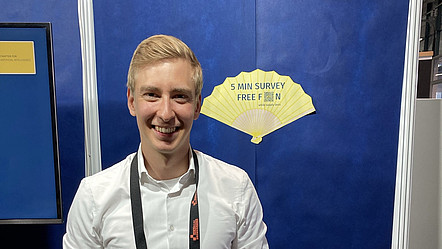
"Start From the Problem, Not From the Technology" Interview with Mattis Hartwig
Mattis Hartwig is a senior researcher at the German Research Center for Artificial Intelligence (DFKI) in Lübeck, where he works on applied AI, and the founder of singularIT GmbH, a company specializing in individual software development. Elena Müller spoke with him at IJCAI. In this interview, he discusses why symbolic ideas are making a comeback inside large language model systems, reflects on the role of simulation and real-world experience in building better world models, weighs the tension between rule-based control and human trust, and warns against treating AI as a single, undifferentiated label.
Interview: Elena Müller, GI
Mattis Hartwig and IJCAI
Elena Müller: Before we get into the content, would you like to introduce yourself and say why you decided to come to IJCAI this year?
Mattis Hartwig: I’m Mattis Hartwig. I did a PhD in computer science, and before that I founded a company, singularIT GmbH, where we do individual software development, a lot of it in applied AI. After my PhD I went to the German Research Center for Artificial Intelligence, DFKI, where I now do research on applied AI.
EM: Have you been to IJCAI before, or is this your first time?
MH: It’s my first time being here in person. I’ve had three papers accepted at IJCAI: the first was during COVID, so that was purely virtual, and for the second I was a co-author while someone else attended. This is the first time I’m actually here myself.
Hybrid AI: Old Ideas, New Revival
EM: One important question for us is whether AI is coming full circle. Not long ago, rule-based AI, systems that follow explicit logical rules like older expert systems, was considered a dead end. Now there’s renewed interest in hybrid systems that combine today’s data-driven models with those older rule-based approaches. Would you say AI is coming full circle, or are we entering a completely new phase?
MH: Transformer-based and large language model architectures are definitely a new phase. If we went back ten years and looked at what people meant by general artificial intelligence, a lot of what we associated with that term back then, we actually have now. At the same time, purely transformer-based models on their own aren’t enough to give us all the skills we want in intelligent systems.
Now we’re seeing old ideas from symbolic AI, from logic and reasoning, trickle back into these systems. They show up in how we orchestrate agents, how we set up plans or chains of thought. I think these old ideas are getting a real revival.
Can Large Language Models Replace Symbolic Reasoning?
EM: Would you say that large language models can ever replace symbolic reasoning?
MH: It depends on how you define a large language model. If you mean an agent-based system with a lot of language model components inside a broader architecture, then yes, it can take over many of those roles. But earlier systems like GPT-3 were basically one model: you give an input,you get text as output. Current assistants connect to a lot of tools, and there’s a lot of symbolic, logic-based or rule-based functionality inside them.
So it’s not really about replacing symbolic reasoning, it’s about making it much easier to use. Earlier, if you wanted to solve something like a traveling salesman optimization, you had to program it in code. Today you tell a large language model what you want, and it produces the code and applies those symbolic ideas for you.
World Models and Learning From Experience
EM: If we look at “smart” AI, what would you say is still missing? One thing people argue is still missing is some kind of world model: an internal understanding of how things behave in the real world, not just knowledge of language or text patterns. Would you agree?
MH: I don’t think you can completely separate those two things. How do children learn? They don’t know at first that a glass breaks if you drop it. They learn it through repeated experiments, through observing, through being told. Some things children just believe and never try out, otherwise they’d jump off houses. So they understand a lot through language too. Words transport a lot of understanding about the world. Much of what we know as researchers comes from reading papers and trusting that something works; we haven’t tried everything ourselves.
So I wouldn’t say it’s one or the other, but having ways to experiment in the real world would definitely enhance the models further. Take autonomous driving: many recent improvements come from very good simulations where agents can try things out and be confronted with complicated situations. That kind of experimentation is difficult in the real world, since we can’t sacrifice humans to teach a car to drive. In simulation we can, and that’s close to what people mean by world models.
EM: You said AI has to experience the real world somehow. With what kind of data and in what kind of settings should this happen without creating risks for people, in autonomous driving for example?
MH: It will come step by step. Simulations will get better and more complex. I often use the chess computer as an analogy: it’s essentially a simulation, and a fairly basic rule-based one at that. Chess computers have superhuman performance, but some simple robots don’t, partly because chess computers can draw on millions or billions of hours of trial and error. Robots in domains like driving, operations or healthcare just don’t have an equally rich simulated environment yet. I think we’ll see better, more realistic simulations where the gap between simulation and real life keeps shrinking, and through robotics we’ll also gather more experience in the real world itself.
Rules, Trust, and Who’s in Charge
EM: Who should be in charge, the data-driven model or the rule-based model? Who should step in, and when?
MH: I’d say no one really knows yet. There’s an interesting paradox here. As humans we tend to trust rule-based systems more, because the rules are explicit. But we trust ourselves even more than that, and we’re not rule-based at all. We have this erratic human level, where people do all kinds of unpredictable things, and that’s still our highest trust level. Then come rule-based systems, then these connectionist, large-language-model-based systems.
I think in the end it will be an interplay. If the language-model world gets too complex, you can’t control everything with rules. You see this with chatbots: when we build one for a company, there are specific interactions they want to support and others they need to defend against. If you try to do that purely with rules, catching a trigger word and stopping there, you end up with a very brittle chatbot. What actually works is a mix: rule-based catch-clauses combined with other models or agents supervising the system. So it ends up being both.
Who Decides the Rules?
EM: How should those rules be determined, and who decides them? I assume it’s mostly companies, but how is that controlled?
MH: There are different levels to this. For a company applying AI, not a foundation model provider but a company using it, you need to define your own compliance rules. You carry the risk: if your chatbot misbehaves, you face the consequences, so you weigh that like any business decision: what upside you gain against what risk you take on. That level is relatively clear.
Then there are bigger questions: how we handle AI in education or healthcare, where people are directly affected. The AI Act covers some of that. And beyond that there’s an even bigger question: how we want to proceed as humans overall, whether we want to keep moving at this speed despite the challenges it brings. On that global level we don’t really have an answer. Countries are competing to move as fast as possible, and there’s no global government to regulate that. But at the levels below, in Europe at least, we do have mechanisms like the AI Act to protect citizens, and at the level of individual products, companies and people are responsible for balancing benefit and risk themselves.
AI Agents in Complex Social Systems
EM: Are we asking the wrong questions about AI? Much of this conversation has focused on individual systems, but AI systems will likely act more and more as participants in complex social settings, alongside humans and other AI. Should research shift from optimizing single systems to designing and evaluating whole social systems and their interactions?
MH: That needs to become a bigger part of the field, yes. We’ll probably reach a point where many transactions and processes are handled entirely by agents. Even now, on the stock market, plenty of trades happen with little human involvement, but they go through very clear gates: a trading agent doesn’t talk to another agent, it talks to the exchange and places an order, a very limited interaction.
Now imagine complex negotiations between agents instead: say I’m selling something and you want to buy it, with no standardized exchange, and we just let our agents figure it out. If that kind of interaction becomes normal at scale, we need a lot more research on it, because we’ll be very dependent on these systems, and if something goes wrong it becomes much harder to trace. It might not be a single system that failed, but a whole chain of interactions, some agent triggering behavior that ripples through others. That’s a realistic scenario, not a doomsday one, where unintended or even intended effects can propagate very far through complex interactions between agents.
Securing Multi-Agent Systems
EM: Do you see any research directions right now that are promising for making AI systems more secure against situations like that?
MH: There’s a lot of work going on. There’s plenty of focus on how these systems can be exploited, but also a lot of research on how to make them safe. In Lübeck, for example, we do a lot of research in healthcare. Everyone agrees it’s important to bring these technologies into healthcare, but we also need to protect patients and their data, so we do a lot of work on anonymization and related techniques.
There’s also research on multi-agent systems, on protecting them, and on defending against things like prompt injection and chain-of-thought injection. There’s a lot of exploration on both sides, offense and defense. As always, it’s a race.
Closing Thoughts: The AI Label Problem
EM: Is there anything else you’d like to share, anything you felt was missing, or anything you’d like to plug?
MH: One thing I’d add: in Germany we see “AI” labeled on so much right now that we need to be a bit careful. I often hear claims like “AI can do this” or “AI can do that,” but AI is really a big toolbox, many different methodologies, tools, agents and algorithms, and right now everything gets thrown into one box.
For Germany, in terms of application and using the potential well, it would help to differentiate between different types of algorithms, models and architectures, and then apply the right ones to the right problems. Right now people often say “let’s do AI” independent of the actual problem. I think we need to reverse that: start from the specific problem and ask what the right way to solve it is. At the moment things are getting less problem-oriented and more technology-oriented, and that’s maybe my final remark.
EM: Thank you very much.
Transcribed and revised with Otter.ai