
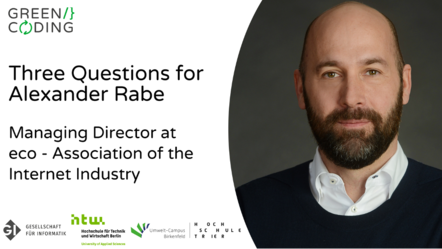
Three Questions for Alexander Rabe
Alexander Rabe is the managing director of eco – Association of the Internet Industry, an associated partner in the Potentials of Green Coding project. In this interview, he explains the significance of strengthening digital infrastructures and how eco is committed to creating sustainability through digitalization.
How does eco work for a more sustainable internet?
As an association of the Internet industry with over a 1,000 member companies, we have played a very special role in the digitization ecosystem since 1995. With our participation in DE-CIX, the world's largest Internet exchange node in Frankfurt, we are also part of the industry ourselves. In purely mathematical terms, this exchange node and the approximately 60 data centers based in Frankfurt could ensure that all offices and apartments in the Main metropolis are heated in a climate-neutral manner by 2030, as a study by the borderstep institute has shown. Unfortunately, however, Germany completely failed to establish a market for buyers of such waste heat. With the alliance for strengthening digital infrastructures founded under our umbrella association, we are committed to ensuring that local and district heating networks are expanded accordingly and that other missing political framework conditions are adapted promptly. This also applies to the energy transition itself:
In order for green electricity to be available in sufficient quantity and at economical conditions for the operation of digital infrastructures and corresponding applications, the expansion of renewable energies must first be massively promoted.
We have been calling attention to these shortcomings for many years. At the European level, we have also joined the Climate Neutral Data Center Pact. We are working with the EU to develop specifications and measurement metrics that are intended to create a uniform European framework for operators of digital infrastructures in the future. For us and our members, making the operation of data centers as efficient as possible has always been a top priority – with success. The energy consumption per workload has decreased twelvefold in the past ten years, which is an impressive increase in efficiency.
What role does green coding, meaning more sustainable software development, already play in your member companies?
Software quality is characterized in particular by efficient programming. The basic idea of green coding is therefore not new. However, the importance of this approach has increased significantly in recent years:
Algorithms and software, which ultimately control servers, have a decisive influence on the energy consumption of digital infrastructures and applications. Here, I see an important building block for more sustainability in digitization, which can lead to significant CO2 savings.
Using the example of AI applications, the Massachusetts Institute of Technology has calculated that optimal programming can result in savings of up to 20 percent in hardware energy consumption. So we should always keep that in mind as a relevant factor when we talk about energy savings. The Hasso-Plattner-Institute for Software Systems Engineering, which is also a member of our association, already has many exciting approaches as to how this knowledge can be passed on to the next generation of developers and IT decision-makers in research and teaching. We urgently need these minds in German companies.
What are your hopes for the Potentials of Green Coding project, in which eco is an associated partner?
I hope that the project will raise awareness for the potential of green coding. Further, I expect concrete best practices from research, which we can transfer to commercial application. Other examples from the digital ecosystem are already leading the way: According to Vodafone, data transmission via fiber optic cable requires around five times less energy than copper connections. The situation is similar if mobile Internet use were to be switched from 3G to 5G across the board: According to the Federal Environment Agency, savings of almost 80 percent are possible here.
Green coding can also be a positive example and underline that only digital technologies and applications can help us to achieve both the UN requirements and our own climate goals in Germany and Europe. We don't have much time left to meet the 1.5 degree target. Networking and digitization are therefore part of the solution for meeting the major challenges of our time, such as climate change. But this can only be achieved if politics, business and research work shoulder to shoulder.
 © Gesellschaft für Informatik e.V. - GI e.V.