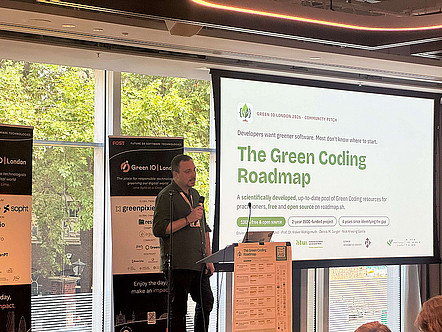

Green Coding Roadmap released – a learning path for sustainable software development goes live
Sustainable software development has so far been difficult to teach in a structured way: knowledge about Green Coding is scattered, inconsistent and hard to access for newcomers. The project "Unlocking the Potentials of Green Coding into Practice", funded by the Internet Society Foundation, set out to close exactly this gap. After two years of project work, the final Green Coding Roadmap has now been released – a freely accessible learning path that structures the field for the first time.
The project was carried out by HTW Berlin (Environmental Informatics Research Group, Prof. Dr. Volker Wohlgemuth) together with the German Informatics Society (Gesellschaft für Informatik e. V., GI) and Umwelt-Campus Birkenfeld. The roadmap was officially presented and released by Dennis M. Junger (HTW Berlin) at Green IO London 2026, one of the leading European conferences on sustainable software development. The roadmap is freely accessible at https://roadmap.sh/r/green-coding.
"Green Coding knowledge has been scattered across blog posts, foundation papers and isolated best practices for years."
— Dennis M. Junger, HTW Berlin
"Developers who wanted to get started simply had no good entry point. We are now providing exactly that – jointly with partners from academia and industry since 2024."
— Prof. Dr. Volker Wohlgemuth, HTW Berlin
Two years of development – structured and participatory
To ensure the roadmap holds up in practice, it was not designed on the drawing board but developed iteratively with the community. Needs were gathered in workshops – among others at EcoCompute, EnviroInfo and the BUIS-Tage – and in focus groups, materials were systematically reviewed, content was implemented in test versions and presented in a public beta. The feedback fed into targeted adjustments. Methodologically, parallel focus groups and UX tests were used to validate content and user guidance in realistic settings. The roadmap itself is implemented as a visual learning path that makes relationships and learning progress graphically traceable.
Project progress is documented by the project team in several papers on ResearchGate, keeping every development step scientifically traceable:
Bridging the Skills Gap: Insights from Professional Software Developers
Requirements Study for a Professional Green Coding Course Format
Joint Evaluation of the Green Coding Roadmap Training – BUIS-Tage Workshop 2026
Six chapters, over 100 topics, openly accessible
The result is published on the open-source platform roadmap.sh and freely accessible. In six chapters and more than 100 topics, the roadmap guides learners from the fundamentals through code and infrastructure to governance questions of sustainable software development. Didactically, it is aligned with Bloom's Taxonomy at the levels Remember – Understand – Apply: content is first recalled, then understood and finally transferred into practical use. The learning path is complemented by a practice toolkit that supports transfer into teams and organisations.
The target audience consists of junior professionals, self-taught developers in the internet industry and, more generally, anyone starting out with Green Coding – precisely those for whom no structured further-training offer in Green Software has existed until now.
Lasting impact beyond the project end
While the project itself ends with the release, work on the roadmap does not: it is designed as a living artefact and will be maintained and extended with new developments. It is flanked by a GREENS paper on the research gap between management frameworks and Green Software and an accompanying doctoral thesis, both of which emerged from the project – ensuring that the roadmap remains scientifically connectable and can evolve in content over time.
Outlook
Once roadmap.sh has integrated the envisaged test and certificate functionality on the platform side, the content side of the project is already prepared: a test will be available for every chapter of the Green Coding Roadmap, and a certificate for successfully completing the entire roadmap. This will develop the roadmap from a pure learning path into a verifiable qualification instrument in the field of sustainable software development.
Links